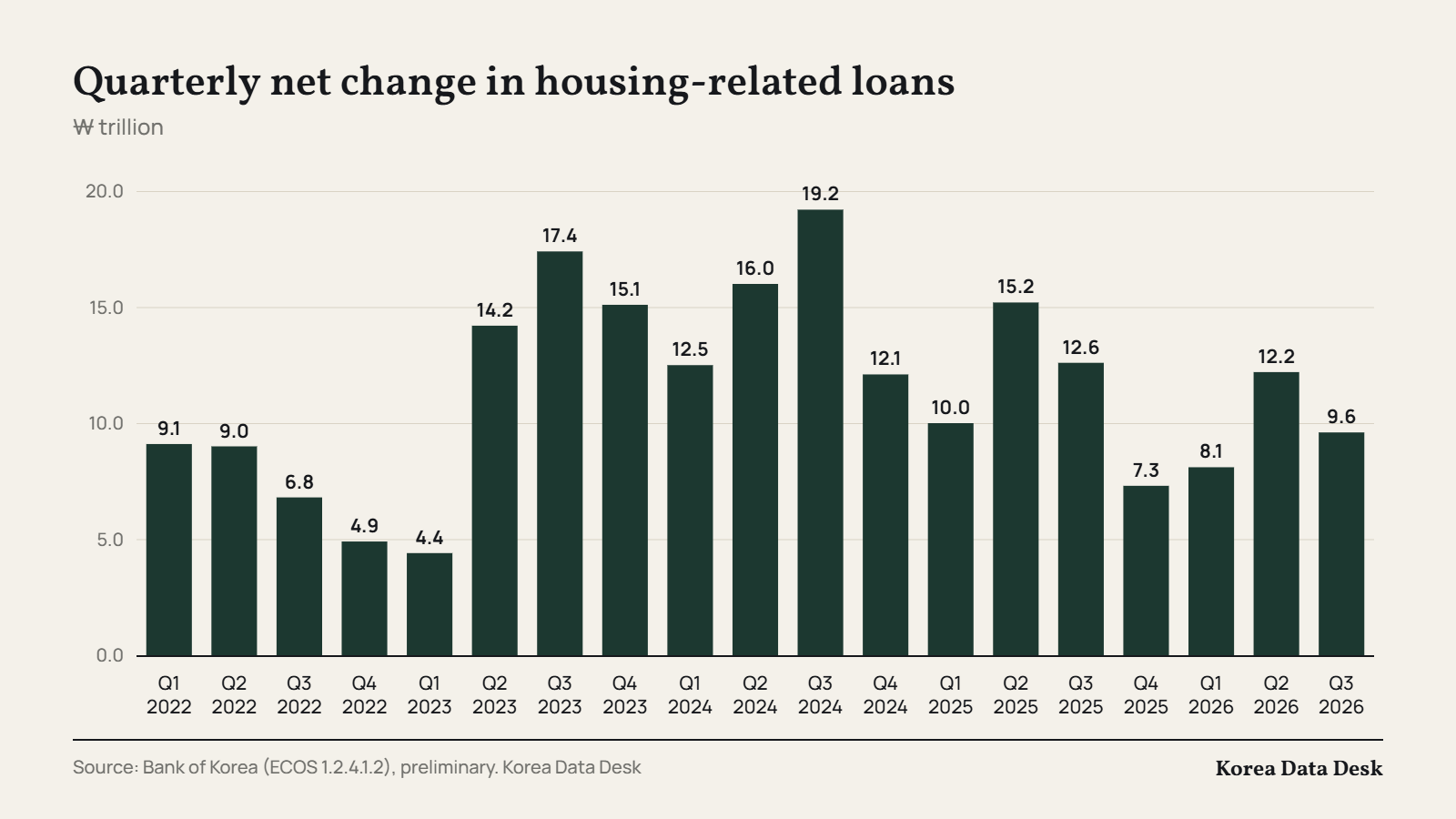
Housing-related household loans reached ₩1,202.3 trillion at the end of September. The quarterly increase was ₩9.6 trillion, down from ₩12.2 trillion in the second quarter.
The Bank of Korea (BOK) published its preliminary household credit figures for the third quarter on 18 November. Total household credit, which adds card and instalment balances to loans, stood at ₩2,030.5 trillion. It rose ₩9.8 trillion in three months, after a ₩25.9 trillion increase in the second quarter.
The headline is the total. For anyone following Korean property, the more useful line sits one row lower: housing-related loans passed ₩1,200 trillion for the first time.
This note does two things with the release. It places the milestone on a five-year series, and it sets state-backed policy lending beside the total.
The quarter in one table
| Balance, end-Sep 2026 (₩ tn) | Change on quarter (₩ tn) | Change on year | |
|---|---|---|---|
| Household credit | 2,030.5 | +9.8 | +3.3% |
| Household loans | 1,896.8 | +4.7 | +3.0% |
| of which housing-related | 1,202.3 | +9.6 | +3.2% |
| of which other loans | 694.5 | −4.9 | +2.6% |
| Sales credit (cards, instalments) | 133.7 | +5.0 | +8.5% |
Housing-related lending was the only loan category that grew. Other loans, which are mostly unsecured credit, fell by ₩4.9 trillion.
Housing debt now accounts for 63.4% of household loans, up from 61.7% in mid-2024.
Two years for each ₩100 trillion
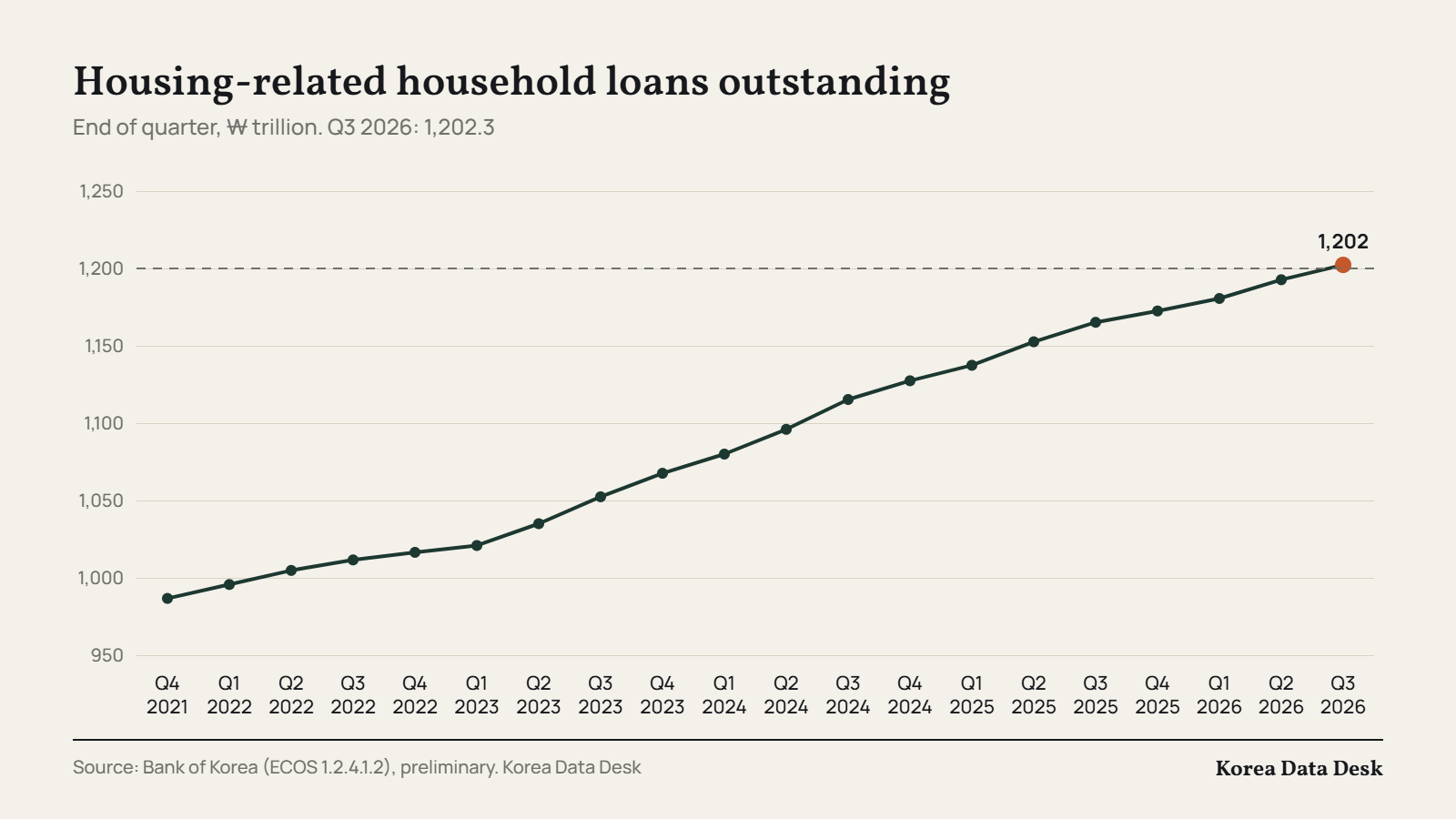
The balance passed ₩1,000 trillion in the second quarter of 2022, ₩1,100 trillion in the third quarter of 2024 and ₩1,200 trillion in the third quarter of 2026. The first step took nine quarters and the second took eight.
The pace inside that period was uneven. Quarterly increases fell below ₩5 trillion in late 2022 and early 2023. They peaked at ₩19.2 trillion in the third quarter of 2024. Over the past four quarters they have ranged between ₩7.3 trillion and ₩12.2 trillion.
Measured year on year, the stock grew 3.2%. A year earlier the same measure was 4.5%.
Why loan data can lag the housing market
A note on timing from the development side. A large share of Korean mortgage lending is not tied to the purchase of an existing home. New apartments are sold before construction starts. A common schedule has the buyer pay about 10% at contract, about 60% in instalments during construction and the balance at move-in.
The instalments are usually financed by group loans (jipdan daechul). The developer arranges them with one or two lenders for all buyers in a project, and they are drawn down as the building goes up. At completion the group loan is repaid, and most buyers replace it with an individual mortgage.
Two things follow. Part of the lending booked in any quarter reflects presales made two or three years earlier. And the completion calendar matters as well as the sales count.
Banks lent, state programmes barely moved
| Lender group | Housing-related loans, end-Sep 2026 (₩ tn) | Change on quarter (₩ tn) | Share |
|---|---|---|---|
| Deposit banks | 787.1 | +9.0 | 65.5% |
| Non-bank deposit-takers | 150.9 | +0.8 | 12.6% |
| Other financial institutions | 264.3 | −0.2 | 22.0% |
| Total | 1,202.3 | +9.6 | 100% |
| Memo: policy loans (KHFC and Housing and Urban Fund) | 340.4 | +2.0 | |
| Memo: bank jeonse deposit loans | 161.3 | −2.4 |
Policy loans are mortgages funded through Korea Housing Finance Corporation and the state Housing and Urban Fund. They are the part of the market the government steers most directly. The BOK lists them as a memo item beside the housing-related total.
In calendar 2023 that memo line rose by ₩60.0 trillion while total housing-related loans rose by ₩51.1 trillion. Over the four quarters to September 2026 the picture is reversed: policy loans rose ₩7.4 trillion while the total rose ₩37.1 trillion.
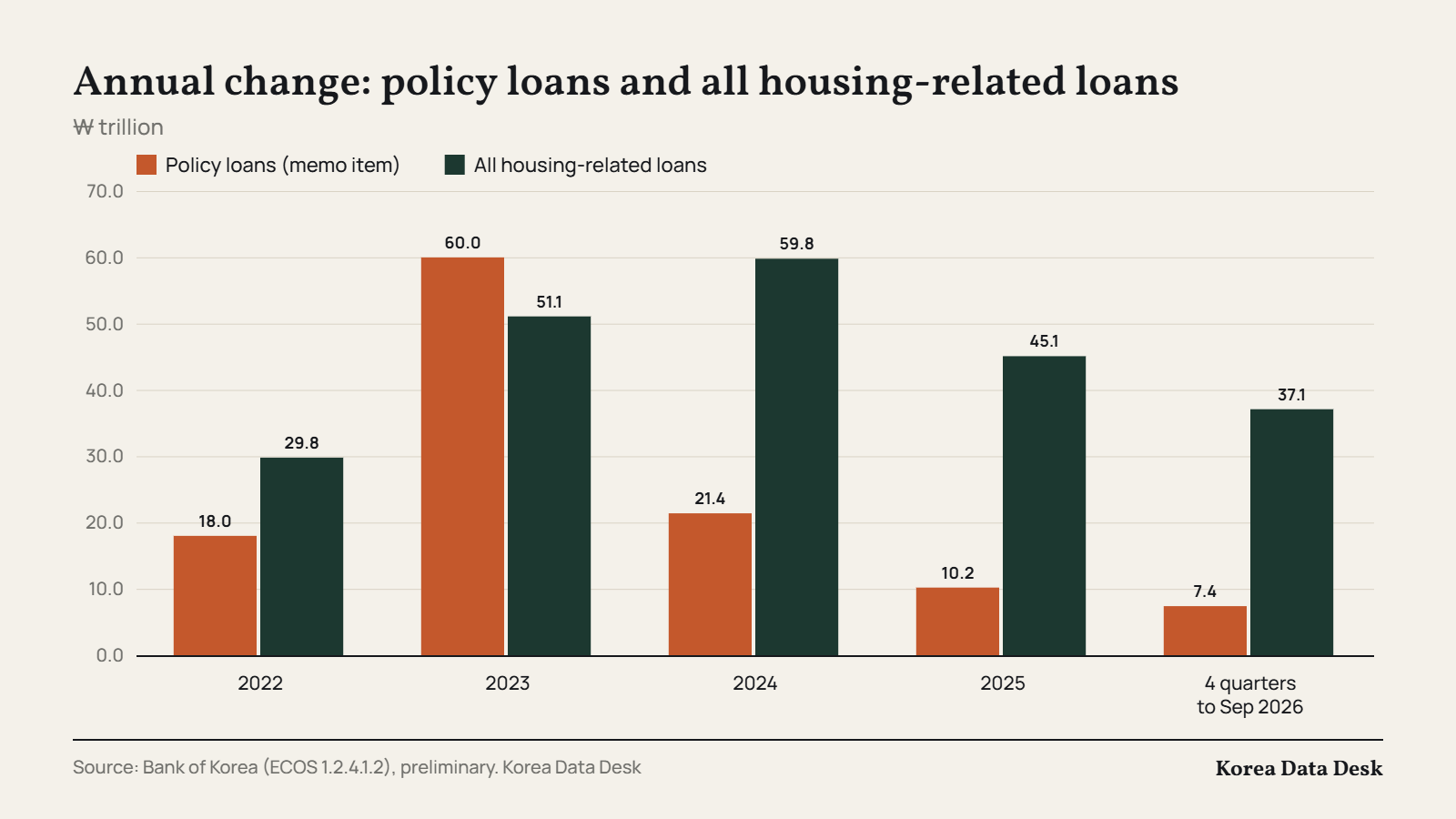
The annual changes are my calculation from the quarterly balances in the same table.
The second memo line also moved. Bank loans for jeonse, the lump-sum deposit lease, fell for a fourth straight quarter. They stood at ₩161.3 trillion, down 4.0% from ₩168.0 trillion a year earlier.
What to watch
- Fourth-quarter move-ins. Balance payments at completion add to lending whatever the level of new sales, so the completion calendar is worth following.
- Monthly transactions. The Ministry of Land, Infrastructure and Transport (MOLIT) publishes home sales counts in its monthly housing statistics. They show the deal flow before the quarterly loan data does.
- Revisions. These figures are preliminary and can change in later releases.
Sources: Bank of Korea, Household Credit in Q3 2026 (preliminary), released 18 November 2026; Bank of Korea ECOS, table 1.2.4.1.2. This article is for information only and is not investment advice.