Three-quarters of this year’s increase came from one product, and most of that from its price.
At 2:09 p.m. on 19 November, the running total on the Korea Customs Service’s clearance system passed $1 trillion. South Korea became the fourth country to export that much in a single year, after the United States, Germany and China. The figure is preliminary and covers goods only.
The speed is the unusual part. Korea’s exports were $709 billion in 2025, itself a record. They passed that level on 5 September this year and added almost $300 billion in the eleven weeks that followed.
This note looks at where the extra money came from, using the trade ministry’s monthly releases and customs data.
The year in one table
| Jan–Oct 2025 | Jan–Oct 2026 | Change | |
|---|---|---|---|
| Total exports | $578.9bn | $930.0bn | +60.6% |
| Semiconductors | $135.4bn | $396.8bn | +193% |
| Everything else | $443.5bn | $533.2bn | +20% |
| Chip share of exports | 23.4% | 42.7% | +19.3 points |
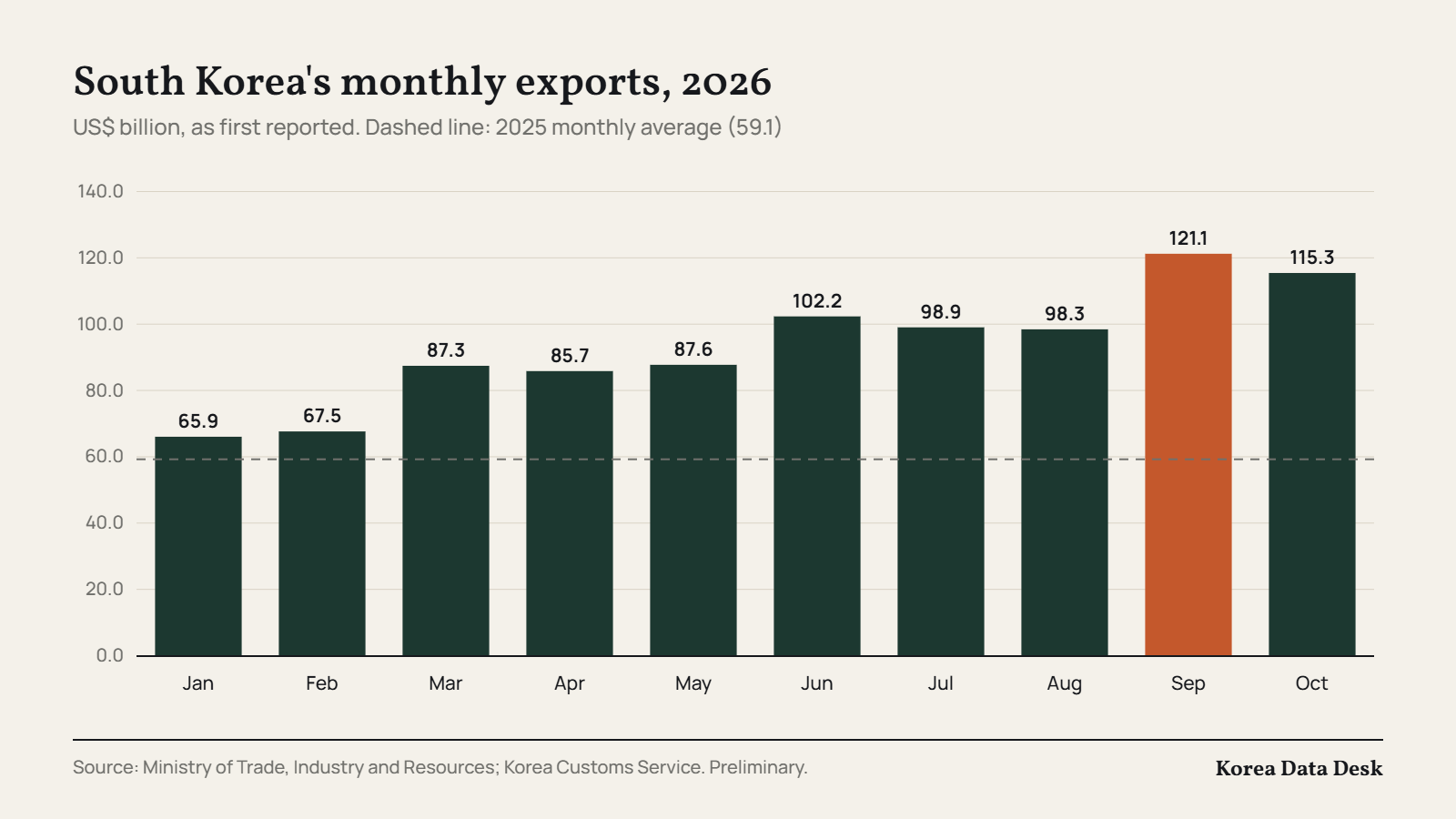
Monthly exports began the year at $65.9 billion and reached $121.1 billion in September, the highest month on record. October was the second highest at $115.3 billion.
Chips supplied three-quarters of the increase
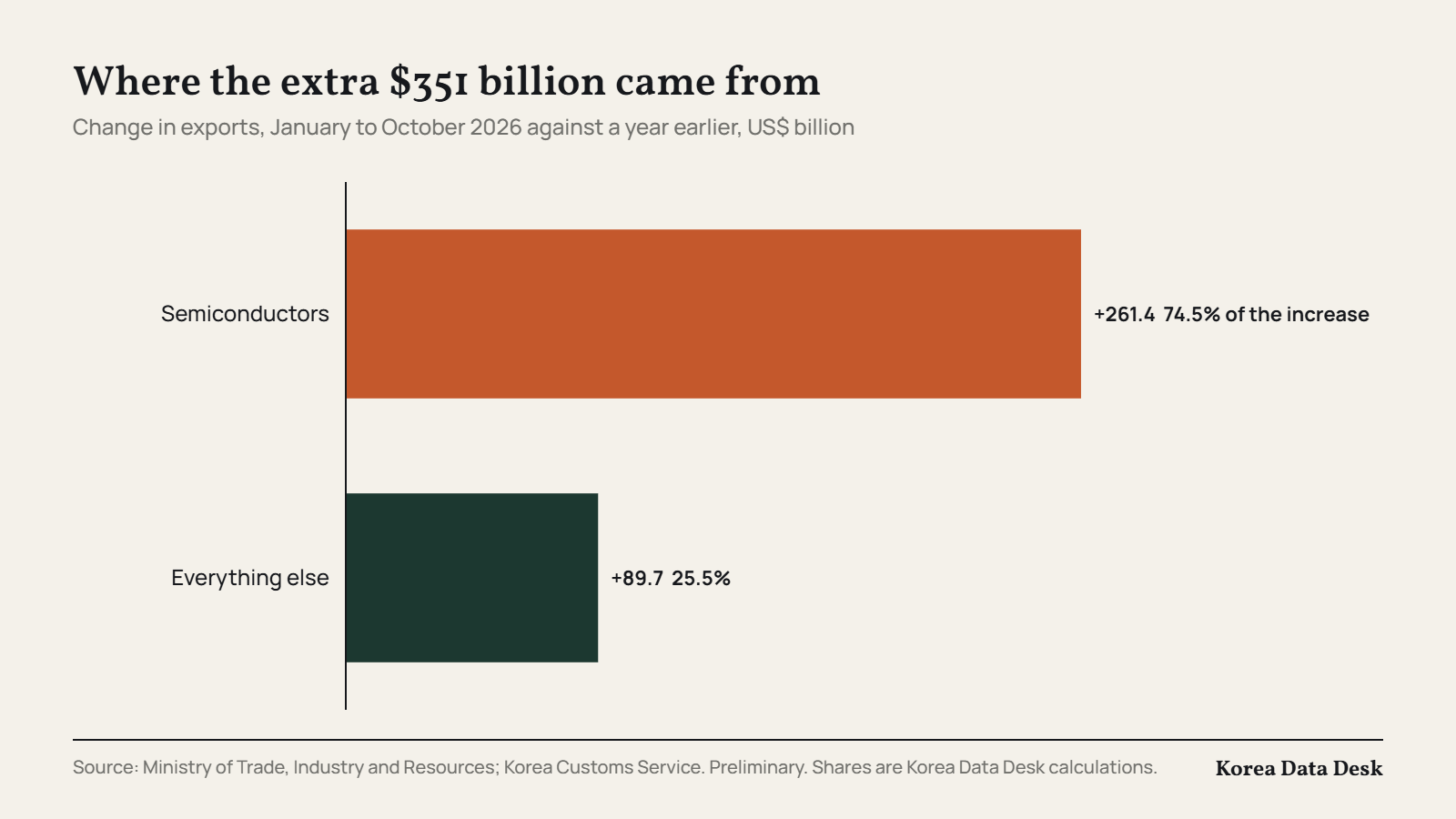
Exports in the first ten months were $351 billion higher than a year earlier. Semiconductors account for $261 billion of that, or 74.5%.
By October the concentration was sharper still. Chip exports were $56.4 billion, about 49% of the month’s total. That is more than the next nine export items combined.
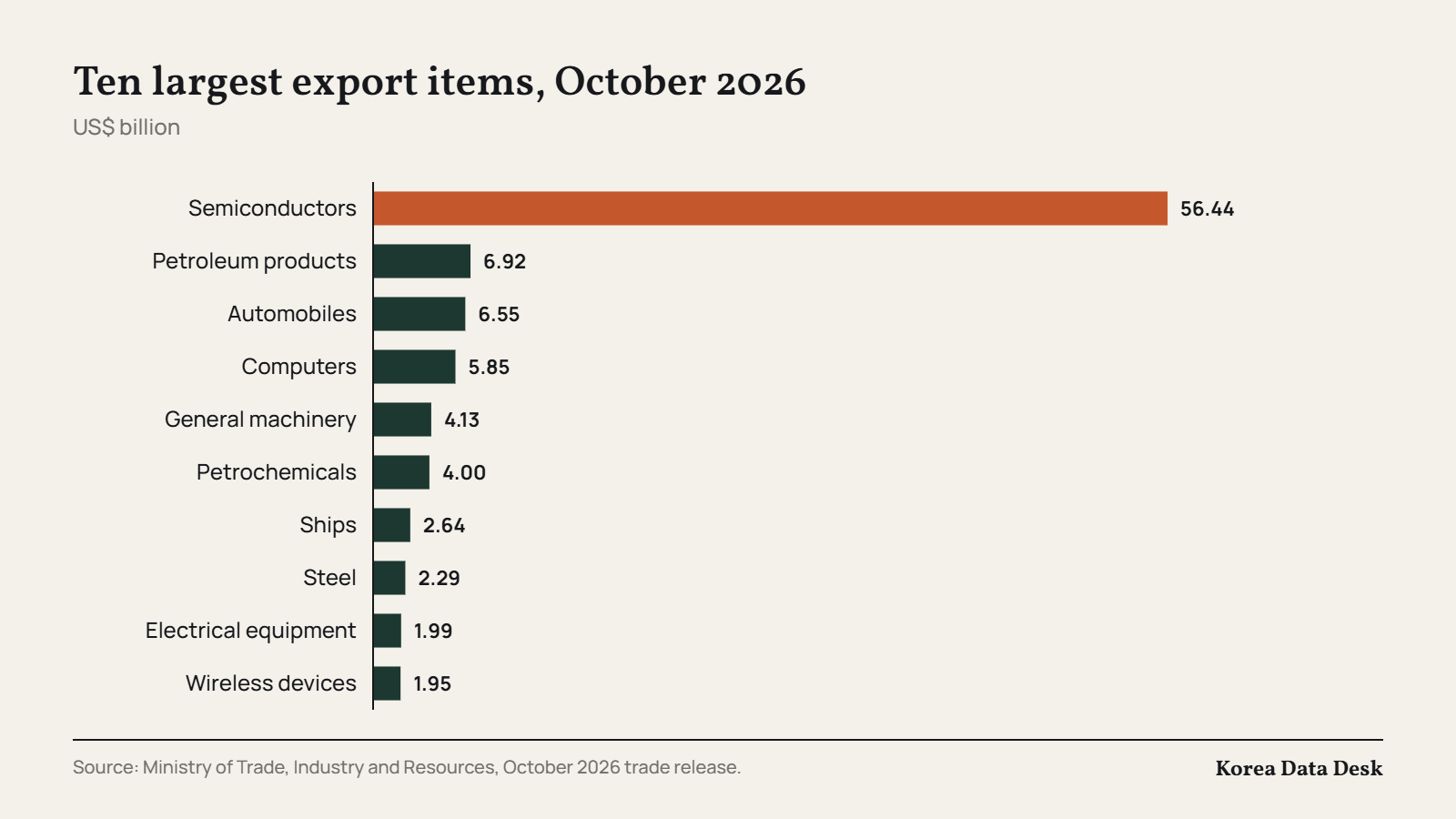
A related item moved with them. Exports of computers were $5.85 billion in October, about six times the level a year earlier. In Korean trade statistics that category is mostly solid-state drives built on memory chips: SSDs made up $5.64 billion of it.
Price did more of the work than volume
The ministry’s releases track fixed contract prices for standard memory products. A 16-gigabit DDR5 chip was priced at $8.70 in October 2025. In October 2026 it was $50.
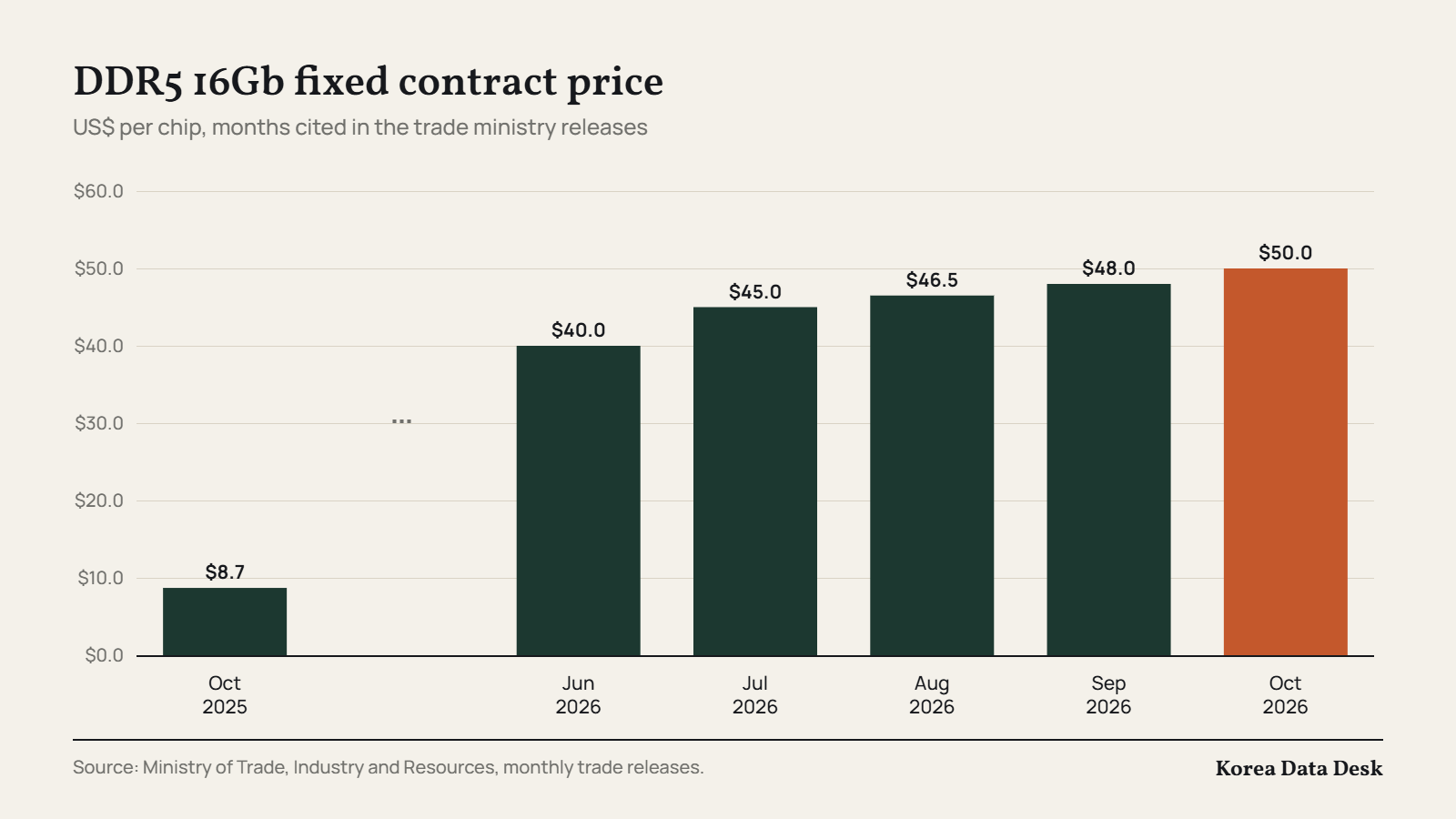
A second number points the same way. Customs data show the total weight of Korea’s exports fell 2.5% in October from a year earlier, the seventh straight monthly decline, while their value rose 94%. Korea is not shipping more goods. It is shipping far more valuable ones.
Weight is a rough measure for chips, which weigh almost nothing, and the ministry says shipment volumes of memory also rose. The official releases do not split chip export growth into price and volume, so this note does not put a number on it. The direction is clear enough: the record owes more to what each chip sells for than to how many leave the country.
Outside chips, growth was ordinary
Exports excluding semiconductors rose 20% in January to October. That is a strong year by Korea’s own history, but it is a different story from the headline 60.6%.
October shows the spread:
| Item | October exports | Change on year |
|---|---|---|
| Petroleum products | $6.92bn | +80% |
| Automobiles | $6.55bn | +18% |
| General machinery | $4.13bn | +24% |
| Petrochemicals | $4.00bn | +28% |
| Ships | $2.64bn | −44% |
| Steel | $2.29bn | +22% |
| Cosmetics | $1.44bn | +58% |
Petroleum products rose mainly because oil prices did; the same release puts the unit price of Korea’s crude imports at $120.5 a barrel, up 62% on the year. Ships fell after a run of large deliveries a year earlier.
Smaller firms saw little of the boom. Exports by small companies were $107.6 billion in January to October, up 9.9%. That is under 12% of the national total.
Where the goods went
China and the United States took almost equal amounts in October: $27.0 billion and $24.9 billion. Shipments to the US were up 186% on the year, to China 134%, and to Southeast Asia 128%.
In each case chips explain most of it. In the first 25 days of October, chip exports to the US were about six times their level a year earlier.
What the milestone does not show
The ranking is not settled. The government expects full-year exports of about $1.17 trillion. Whether that makes Korea the world’s fourth-largest exporter depends on the Netherlands, which exported $989 billion in 2025 and is also expected to pass $1 trillion this year. Dutch trade figures include a large volume of goods that pass through its ports on the way elsewhere, so the two totals are not like for like.
The surplus is very large. The trade surplus for January to October was $294.9 billion, about three times the previous full-year record of $95.2 billion set in 2017.
One price carries a great deal. When 43% of exports come from a product whose benchmark price moved from $8.70 to $50 in twelve months, the total will follow that price in both directions. The same arithmetic that produced this year’s record would work in reverse.
What to watch
- The customs service’s figures for the first 20 days of November, which include the chip share of exports
- The ministry’s November trade release on 1 December, with memory contract prices
- The Netherlands’ full-year trade figures, due early in 2027
Sources: Ministry of Trade, Industry and Resources, October 2026 trade release and earlier monthly releases for 2026; joint announcement by the ministry and the Korea Customs Service, 19 November 2026; Korea Customs Service, trade statistics for October 2026 and 1–10 November 2026; Ministry of SMEs and Startups for small-company exports. All figures are preliminary unless stated. This note is information about published data and is not investment advice.